
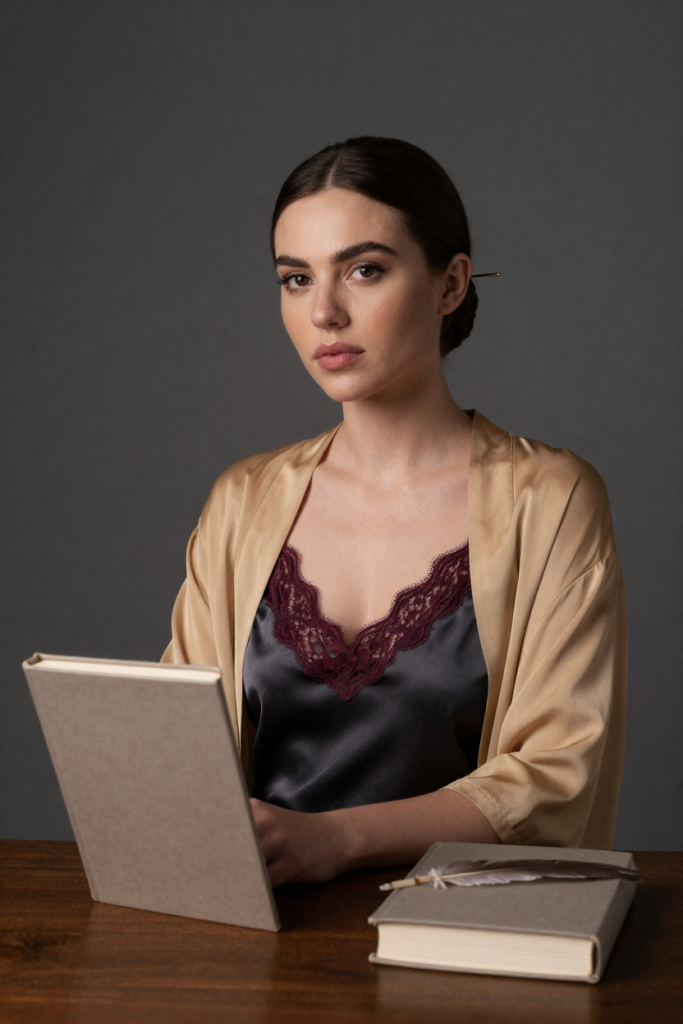
Half the frames made in this room happen after dark, under lamplight, against charcoal walls with gold at the edges. Low light is the most requested mood in the studio and the easiest to ruin, because the model treats darkness as an invitation to invent: skin goes waxy, jewellery multiplies, the room fills with candles nobody briefed. The fix is not more darkness words. It is fewer, harder facts.
Name the source, not the mood
‘Moody’, ‘dark’ and ‘cinematic’ are moods, and moods are re-rolled per frame. A source is a fact: ‘one warm lamp at frame left, charcoal wall behind’. Two sources at most, each with a direction. Skin honesty follows from source discipline — a single named lamp gives the model one shadow to draw, and skin lit by one lamp looks like skin. Three unnamed moods give it weather, and skin in weather looks painted.
One lamp, named and placed
‘Warm lamplight from the left’ — source, temperature, direction, in that order.
Keep the desk in the light’s edge
The closed biography and the feather sit at the edge of the lamplight — enough to read as bench marks, not enough to compete with her.
Cull for waxy skin first
In low light, skin texture fails before faces do. Judge the skin, then the card.
Questions
Why does jewellery multiply in dark frames?
Small bright details are easy texture for the model to invent. Brief jewellery off, or accept re-rolls.
Can the editor rescue a waxy frame?
Rarely at 21 credits’ worth of honesty. Re-brief with a named source; it is cheaper than repair.
What wall colour flatters low light?
Charcoal and deep tones give lamplight somewhere to fall. Pale walls in a ‘dark’ brief confuse the model into daylight.